

“O Lord, my heart is not lifted up; my eyes are not raised too high; I do not occupy myself with things too great and too marvelous for me. But I have calmed and quieted my soul, like a weaned child with its mother; like a weaned child is my soul within me. O Israel, hope in the Lord from this time forth and forevermore.”
Psalm 131:1-3
Is there something you cannot stop thinking about?
You know what it is. It might be loud or it might be quiet, urgent or familiar, recent or years old. Whatever it is, it has been turning over in your mind without your permission, and it’s wearing you out in a way that nothing about your day fully explains.
We have been told this is just how life feels now. It isn’t. It’s what happens when a soul has not been quieted. And an unquieted soul will wear out the body underneath it.
I’m not writing this from the outside. I know how it sounds when I say your soul has not been quieted. It sounds like the kind of sentence that comes with a candle and a discount code. But stay with me. There’s a name for what’s happening. There’s a reason. And there’s a way out. The way out is older than most of us were taught. And stranger. And it lives in the body.
The Loop Has a Name
Before we get to the psalm, you need to know what’s actually happening when you can’t stop thinking. Understanding it changes how you respond to it.
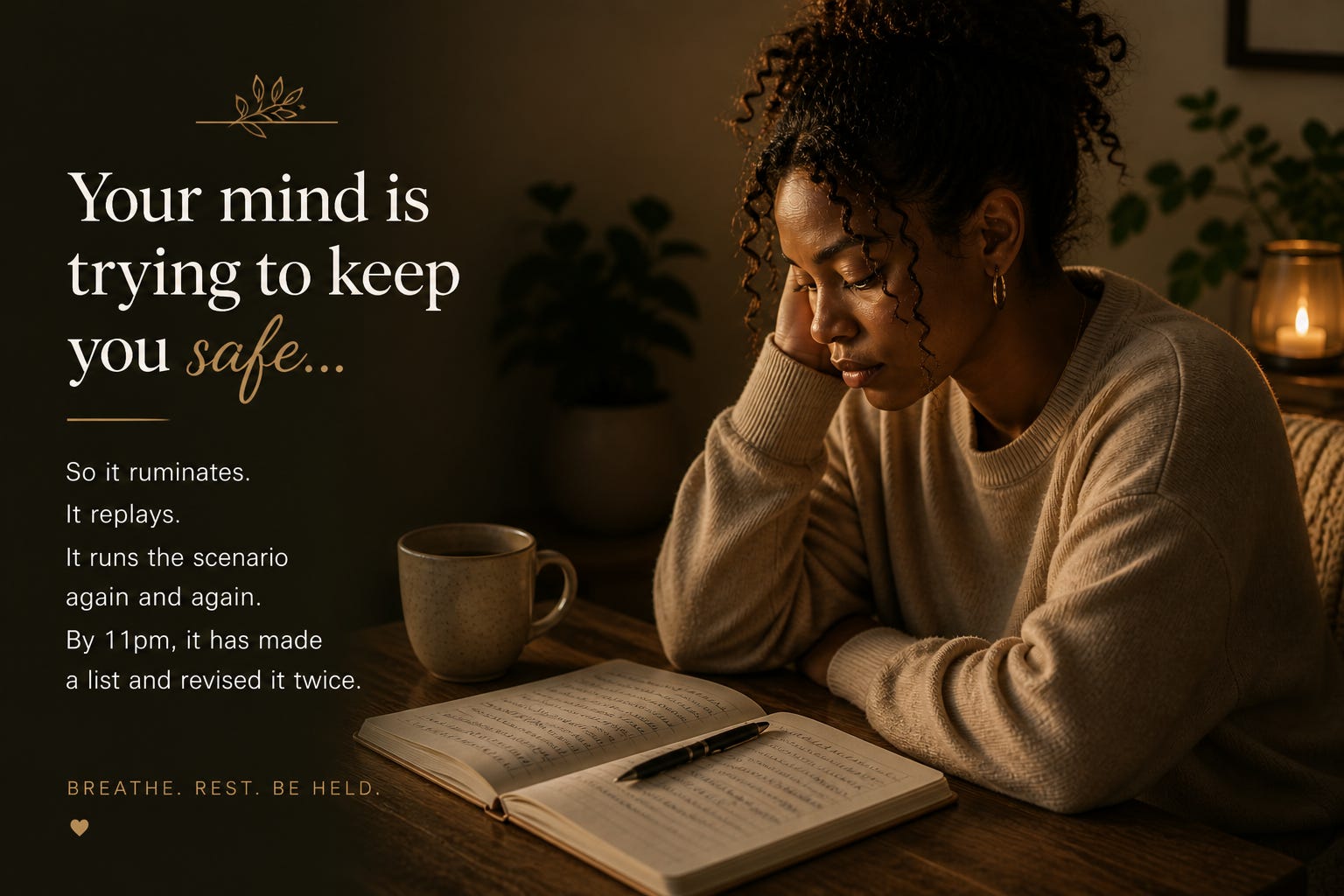
When your nervous system senses uncertainty, even the low grade kind, like I haven’t figured this out yet, your amygdala lights up and signals threat. Your brain responds the way it has always responded to threat. It tries to think its way to safety. So it ruminates. It runs the scenario again. It checks the angles. It rehearses the conversation. By 11pm, it has made a list and revised it twice.
Here’s the trick the brain plays on us. Because thinking feels like doing, you can spend three hours in this loop and feel productive, when really your nervous system is just simulating every possible outcome in advance, hoping one of the simulations will let it relax. There is no version of this where the simulations finally satisfy your amygdala. The amygdala does not believe in satisfaction.
This is why you can wake up exhausted without having moved a single muscle. The thinking itself is the work, and it is depleting you.
The cruel irony is that the only way out of this loop is something the loop will not let you do.
Stop.
You can’t think your way out of overthinking. You can’t strategize your way to stillness. The mind has to be quieted, and the mind can’t quiet itself. It has never been able to. It needs something else to interrupt it. That something else is your body. The picture of what that looks like is in a psalm so short you could miss it.
A Lap, Not a List
Psalm 131 is three verses long. Considering everything else David wrote, that restraint is striking. There’s no enemy to defeat here, no lament, no sweeping request. Just a man who has finally learned something most of us are still trying to learn.
“O Lord, my heart is not lifted up; my eyes are not raised too high; I do not occupy myself with things too great and too marvelous for me. But I have calmed and quieted my soul, like a weaned child with its mother; like a weaned child is my soul within me. O Israel, hope in the Lord from this time forth and forevermore.” Psalm 131:1-3
Sit with the image. Like a weaned child with its mother.
A nursing child cries for the mother because the child needs something from her. Milk, comfort, survival. A weaned child has stopped needing the mother for that, and yet still climbs into her lap. Not crying. Not demanding. Simply resting against her, quieted by nearness instead of by need. The relationship is no longer transactional. It has become contemplative.
David’s soul has finally stopped crying for things. He has stopped occupying himself with what’s too great and too marvelous for him. The futures he can’t control, the questions he can’t answer, the outcomes he can’t guarantee. In that release, he has found something he could not find while striving. The simple, embodied peace of being near God for no reason other than that being near is enough.
The weaned child is doing the hardest thing a child ever does. Stop asking.

Your Body Already Knows
Here’s what we’ve lost in the way we’ve been taught to think about prayer and meditation. The body has a built in mechanism for the kind of quieting Psalm 131 describes, and it isn’t metaphorical. It’s physiological.
When you slow your breath, particularly when your exhale becomes longer than your inhale, you stimulate the vagus nerve, the master regulator of your parasympathetic nervous system. The vagus nerve sends a signal directly to the brain that the body is safe, which begins to calm the amygdala, which begins to interrupt the rumination, which finally lets the mind soften. This is why meditation works. You aren’t willing your mind into stillness. You’re giving your body the cues it needs to feel safe, and a safe body lets the mind quiet itself.
Which is exactly the posture David is describing. The weaned child in the mother’s lap isn’t striving to be calm. The child is calm because the body is being held, and the held body has nothing left to brace against.
David is describing a body that has found its place. Leveling out, becoming smooth, settling like water that has stopped being disturbed.
Christian meditation, especially the kind anchored in scripture, is the practice of giving your body that place. Over and over, until your body stops treating it as foreign. This is what scripture means by abiding. Living in nearness to Him.

The Practice
This five minute meditation will help your soul actually quiet, not just understand that it should.
The meditation uses your breath, the image of the weaned child, and a short repeatable prayer to let your body receive the kind of stillness Psalm 131 describes. You do not need to do anything to prepare. Find somewhere you can sit or lie down without being interrupted for five minutes. Close your eyes if you can. Let yourself be led.
If now is not the time, save this and come back when it is. The meditation will keep.
When you finish, notice if your mind feels even slightly less crowded than it was five minutes ago. Notice that something in you settled, even though nothing about your day changed.
If you would like a more immersive experience of this same meditation, with breathwork visuals, the weaned child image to rest in, and space to journal what surfaces, you can find it inside The Resting Room.
The thing you cannot stop thinking about will still be there when you press stop. But you might find it sitting in a quieter room.

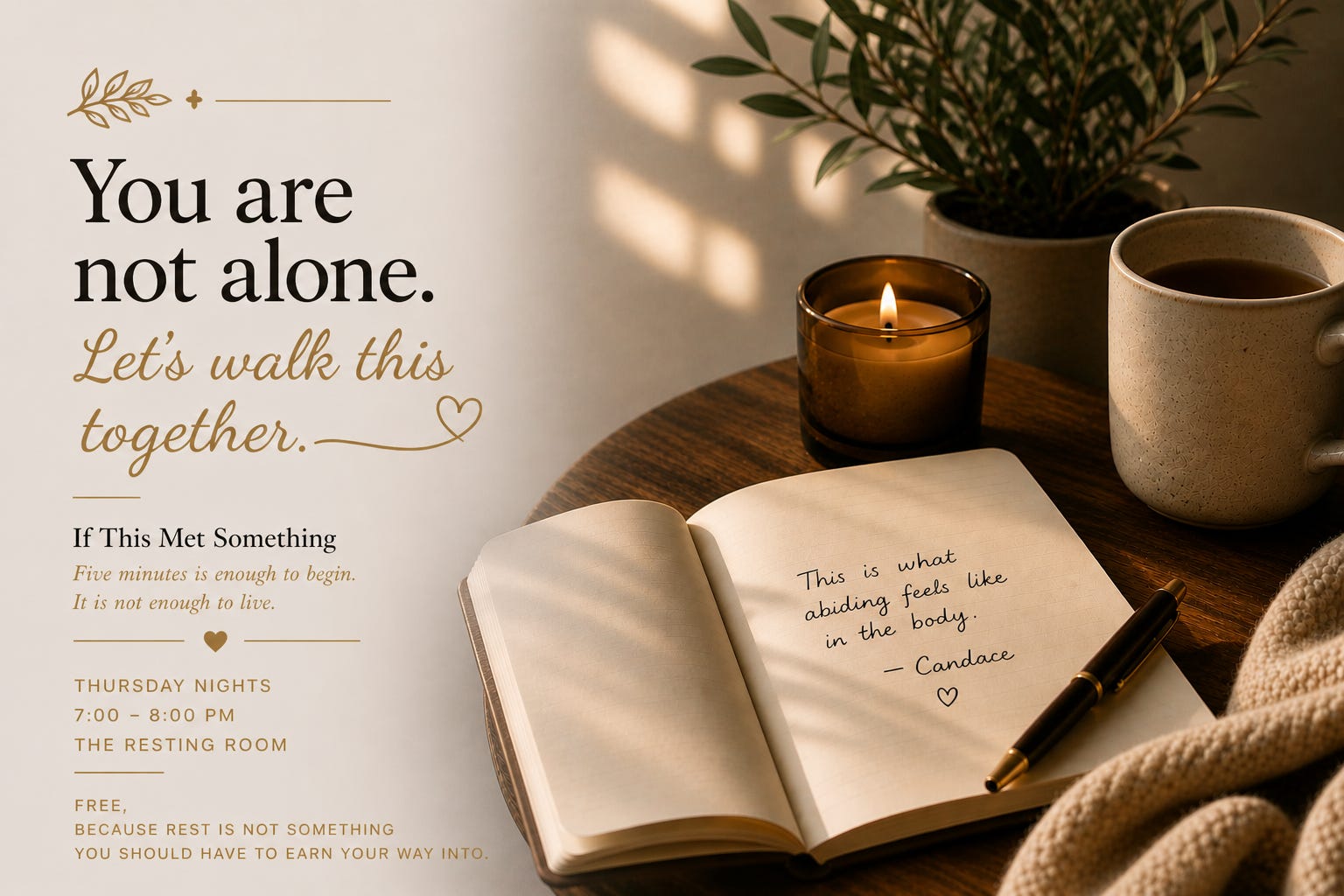
If This Met Something
Five minutes is enough to begin. It is not enough to live.
What your nervous system actually needs is repetition. Rhythm. Enough times that the body remembers without being told.
That’s what The Resting Room is for. Thursday nights, an hour of being quieted in real time, with other people who are also tired of carrying things into the next day. Breathwork. A scripture passage we don’t analyze. A guided meditation. A breath prayer for the week. We send each other out softer than we came in.
No camera if you don’t want it. No prior experience needed. No performance. Free, and staying free, because rest is not something you should have to earn your way into.
Your body has been holding for a long time. Come let it be held instead.
This is what abiding feels like in the body.

The audio for this meditation is at the top of this page. When you’re ready, scroll up and breathe it with us.


